


From a telescope in Mangaluru to the intergalactic medium.
A student observatory. An IOAA Silver Medal. Alumni probing Fast Radio Bursts at the University of Chicago. This is where the universe opens up — and it starts in a classroom of 40.
A private observatory.
Run by students.
Inaugurated on February 13, 2021 by Dr. Prajval Shastri — astrophysicist at the Indian Institute of Astrophysics, Bangalore, who specialises in the phenomenology of active galaxies driven by supermassive black holes — the CFAL Observatory is one of its kind in Mangaluru. It is a working scientific facility, not a demonstration telescope brought out once a year for a science fair.
The primary setup is a 127mm Explore Scientific FCD100 APO Refractor — an air-spaced triplet apochromatic telescope with HOYA FCD100 extra-low dispersion glass that virtually eliminates chromatic aberrations — mounted on a CEM60 iOptron equatorial mount with precision tracking for deep-sky imaging. For astrophotography, students use the ZWO ASI071MC Pro cooled astro camera with an Optolong 2" L-Enhance dual narrowband light pollution filter — the same class of equipment used by serious amateur observatories worldwide.
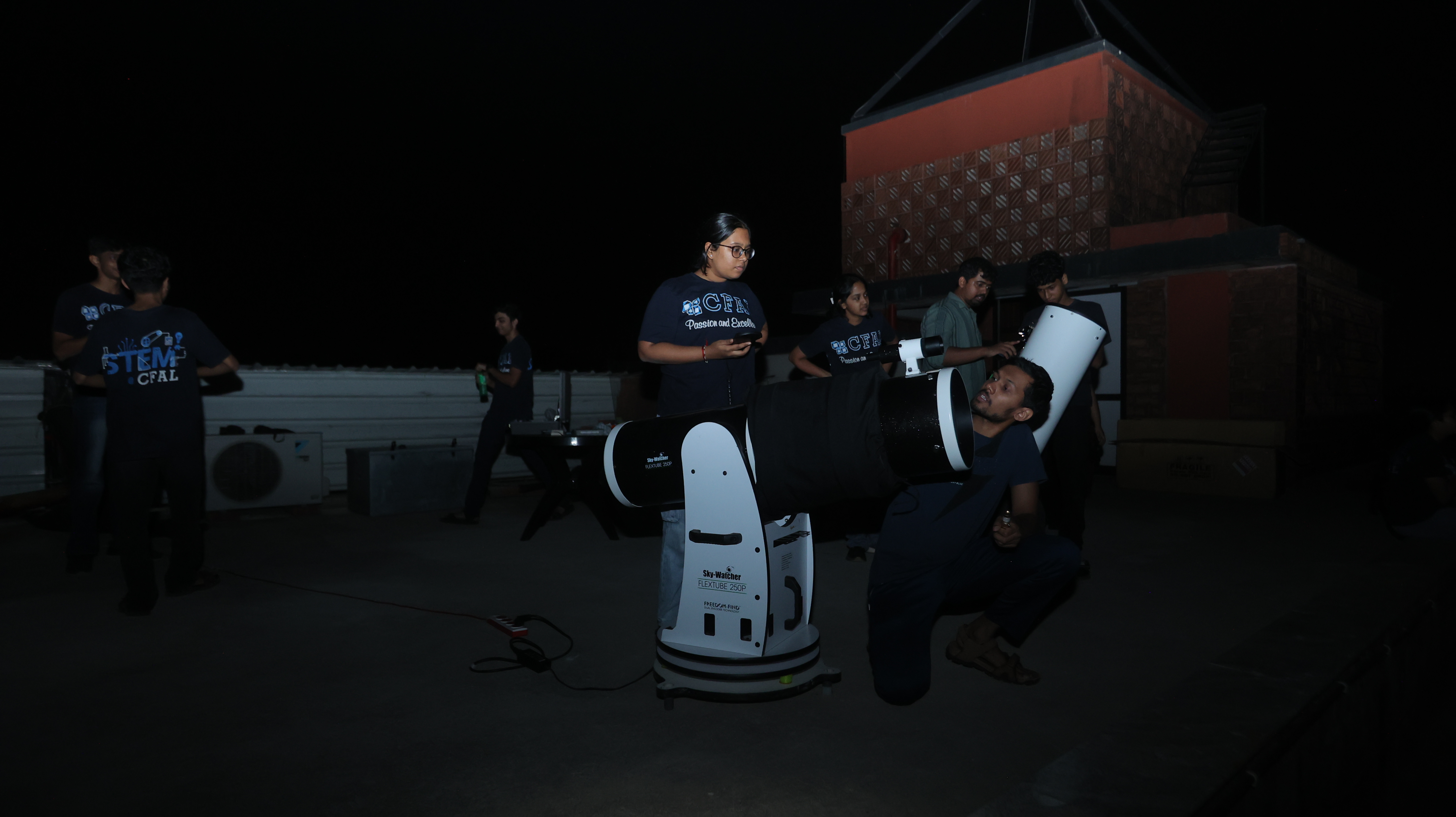
For visual astronomy and public outreach, the club operates a Skywatcher 10-inch motorised GoTo Dobsonian — a large-aperture telescope that allows students and visitors to observe planets, star clusters, and galaxies in real time. For planetary and lunar imaging, a ZWO ASI290MC planetary camera is used with a 2X Barlow lens on the ED127, delivering high-resolution captures of Jupiter, Saturn, the Moon, and solar system events.
Students conduct ongoing solar research — photographing sunspots through dedicated solar filters, tracking magnetic activity cycles, and comparing observations with real-time data from SpaceWeatherLive. In April 2021, the club observed and captured the Lunar Occultation of Mars live through the 10-inch GoTo — the crescent Moon passing directly between Earth and Mars. The club shares original raw data (Lights, Darks, Flats) under a Creative Commons Attribution-NonCommercial 4.0 International Licence, allowing budding researchers anywhere to practise professional-grade data reduction.
| Equipment | Specification | What Students Do With It |
|---|---|---|
| Primary Telescope | 127mm Explore Scientific FCD100 APO Refractor (air-spaced triplet, HOYA FCD100 ED glass) | Deep-sky imaging, solar observation, astrophotography — the primary research instrument |
| Mount | CEM60 iOptron equatorial mount | Precision tracking for long-exposure deep-sky photography |
| Deep-Sky Camera | ZWO ASI071MC Pro (cooled astro camera) | High-definition astrophotography — nebulae, galaxies, star clusters, sunspots |
| Light Pollution Filter | Optolong 2" L-Enhance dual narrowband | Enables deep-sky imaging even from Mangaluru's light-polluted skies |
| Visual Telescope | Skywatcher 10" motorised GoTo Dobsonian | Visual astronomy for students and public outreach events |
| Planetary Camera | ZWO ASI290MC + 2X Barlow | High-resolution planetary and lunar imaging — Jupiter, Saturn, Moon, Mars |
| Solar Filters | Dedicated solar filter for ED127 | Safe, detailed sunspot observation and solar activity tracking |
| MakerSpace Access | 3D printers, laser cutters, electronics lab | Custom telescope mounts, sensor prototypes, data collection systems |
From classroom to representing India.
Five stages. One path.
Selection for the Indian team at the International Olympiad on Astronomy and Astrophysics (IOAA) involves a five-stage national process overseen by the Homi Bhabha Centre for Science Education (HBCSE). CFAL students have successfully navigated every stage of this pipeline.
Grade 8 in Mangaluru.
Silver Medal in Beijing.
Prathyush P. Poduval
Prathyush's journey is not an accident. It is the product of an ecosystem — the Math Circle built his problem-solving foundations, the Foundation Programme gave him conceptual depth, the Olympiad camps built his stamina, and the Astrophysics Club gave him the sky. Every element worked together.
The pipeline keeps producing.
Prathyush's story was 2018. The programme has only strengthened since.
Mrinal D. Bhat
National Top 1% in Astronomy. State Top 1% in Chemistry and Physics simultaneously. Shortlisted for INAO 2026. One of the rarest multi-subject achievements in India.
Akshith Ram K
Shortlisted for the Indian National Astronomy Olympiad (INAO) 2026. On the path that Prathyush walked — now with an even stronger support ecosystem behind him.
Muralidhar Rao
Cleared both INMO (Mathematics) and INAO (Astronomy) simultaneously — two years running. One of the rarest dual qualifications in Indian Olympiad history. IMOTC attendee. Published in Putnam analysis.
10 NSE National Top 1% Achievers
In the 2025 National Standard Examinations, multiple CFAL students achieved national top 1% rankings across Physics, Chemistry, Astronomy, and Biology.
From CFAL to the frontiers of astrophysics.
The Astrophysics Club and Olympiad pipeline don't end at a medal ceremony. They lead to careers at the world's most prestigious research institutions. CFAL alumni are now working on problems that shape our understanding of the universe.
Sunil Simha
Dept. of Astronomy & Astrophysics
Sunil's doctoral research at UC Santa Cruz and current work at UChicago focuses on using Fast Radio Bursts (FRBs) — millisecond-duration radio transients from distant galaxies — to probe the ionised matter in dark matter halos and the intergalactic medium.
His work includes the FLIMFLAM Survey (mapping baryons along FRB sightlines), host galaxy localisation using MeerKAT and ASKAP radio arrays, and a novel approach to probing the Andromeda Galaxy using CHIME/FRB data. This research addresses the "missing baryon problem" — one of cosmology's fundamental open questions.
He has also conducted follow-up observations of Type Iax supernovae, using ultraviolet-to-optical photometry to model stellar evolution. His work has been extensively cited in the Astrophysical Journal.
The trajectory: CFAL classroom → IISc/research foundations → UC Santa Cruz (PhD) → University of Chicago. From Mangaluru to the intergalactic medium.
Prathyush Poduval
IOAA Silver Medal → IISc Bangalore → UC Irvine (doctoral research). Ross Math Camp, Ohio State. Karnataka KVPY topper.
Kenrick Pinto & Raksha Pai
Both pursuing MS at the University of Texas at Austin — engineering and applied sciences. From the same CFAL ecosystem that produced the astrophysicists.
"The student who learns to photograph sunspots at 15 is the same student who probes Fast Radio Bursts at 25. The curiosity doesn't change. The telescope gets bigger."
What students actually do here.
The CFAL Astrophysics Club is not a name on a list of extracurriculars. It is a working scientific community — student-led, faculty-supported, and connected to India's national astronomical infrastructure.
Observational Research
Evening and night sky observations conducted regularly. Solar tracking through dedicated filters. Lunar occultation captures. Deep-sky imaging with the ZWO ASI071MC Pro on the FCD100 APO refractor. Students learn to capture, stack, and process astronomical data.
Astrophotography
Student-captured images of sunspots, nebulae, galaxies, Jupiter, Saturn, and the Moon. Raw data (Lights, Darks, Flats) shared under Creative Commons licence. A full Observatory Wiki with operational guides for telescope setup, camera configuration, and data processing — all created by students.
Star Party & Astronomy Nights
Annual Astro Night events open to the public — most recently February 2025 at the Akashbhavan campus (6:30–10 PM). Live sky observations of Jupiter, Saturn, globular clusters through the 10-inch GoTo Dobsonian. Free admission. All ages welcome.
IIA Partnership
Collaboration with the Indian Institute of Astrophysics. CFAL participates in PACK (Platform for Astronomy Communicators in Karnataka). Night sky watches, public talks, workshops. Dr. Prajval Shastri inaugurated the observatory in 2021 and continues to engage with students.
Pilikula Science Centre
Student observations and Q&A sessions at the Mangaluru planetarium. Connecting classroom learning to public scientific infrastructure.
Astrophysics Classes
Formal astrophysics instruction for Grade 1 to Grade 12 students — one of the only institutions in Mangaluru offering this across the full age range. Classes cover observational astronomy, celestial mechanics, and the physics of the cosmos.
The club maintains an active digital presence through Instagram (@cfalastroclub) and a dedicated Observatory Wiki at cfalastronomy.notion.site — with operational guides for telescope setup, camera configuration (ASI071MC Pro, ASI290MC), calibration frames, and data processing using NINA and DeepSkyStacker. All documentation created by students.
Astrophysics is not learned alone.
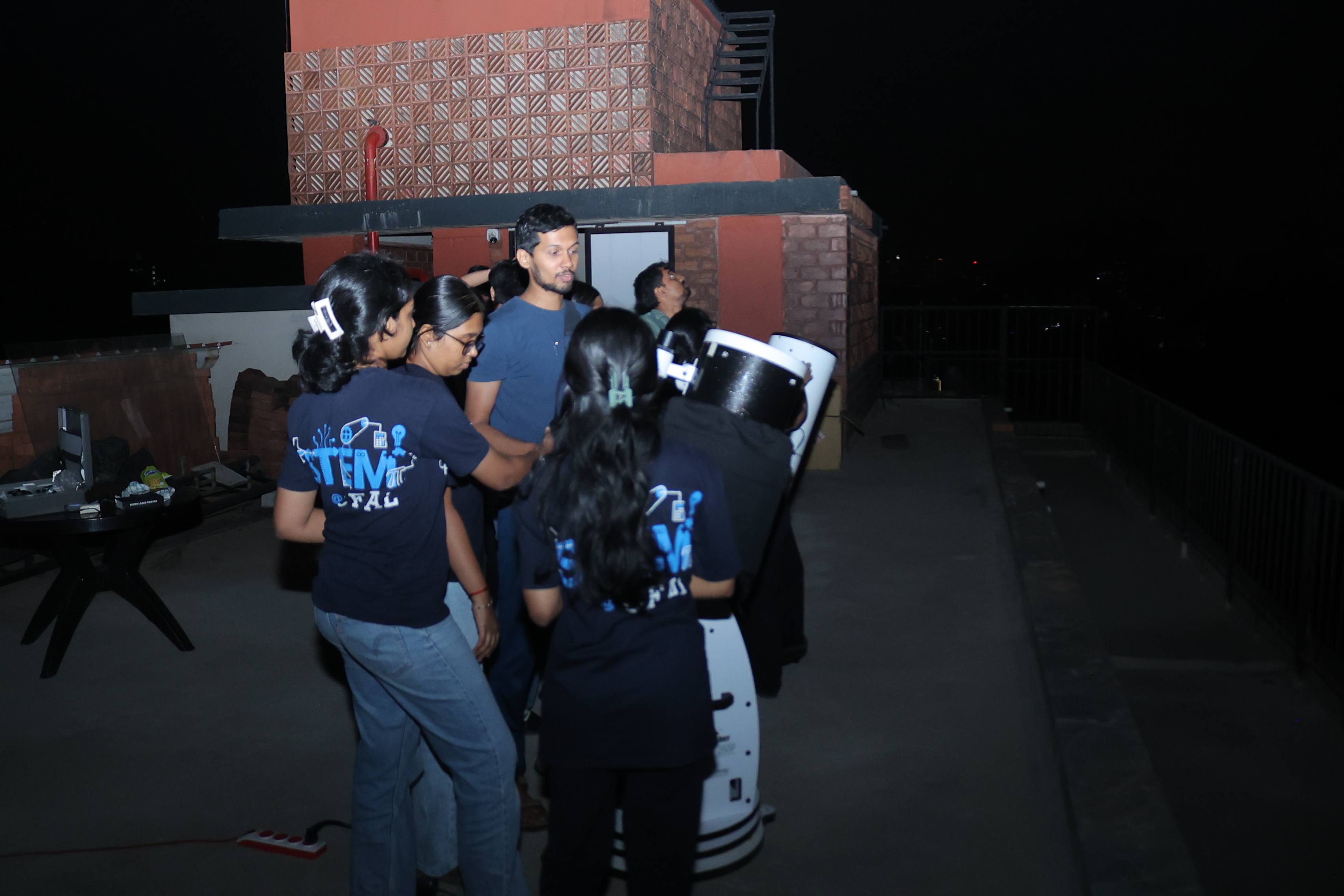
CFAL's "Connected Wisdom" series and annual Star Party events bring the community into the observatory. The most recent Star Party (February 2, 2025, Akashbhavan campus, 6:30–10 PM) featured a talk by Dr. Prajval Shastri — the same astrophysicist who inaugurated the observatory in 2021. Students and families observed Jupiter, Saturn, and deep-sky objects through the 10-inch GoTo Dobsonian. Admission is always free.
The inaugural event in 2021 also featured an interactive session with Nandita Jayaraj, coordinator of The Learning Centre Library, and the unveiling of the 2021-22 Indian Women in Science Calendar — with panellist Smitha Hegde (pteridologist). The observatory is part of CFAL's Nature Perspectives curriculum, which is committed to making science — including astronomy — accessible and enjoyable for everyone.
The coastal Karnataka region is emerging as a hub for amateur astronomy, supported by organisations like the Poornaprajna Amateur Astronomers' Club (PAAC) in Udupi — a community that has operated for over 20 years. CFAL's Astrophysics Club is part of this regional ecosystem, contributing to a culture where science is not just studied but practised.
From Aryabhata to Arcsecond Precision.
India's relationship with the sky is ancient. The Vedanga Jyotisha tracked solar and lunar cycles 3,400 years ago. Aryabhata modelled planetary motion and proposed the rotation of the Earth in the 5th century — a millennium before Copernicus. Vikram Sarabhai and Homi Bhabha built ISRO and TIFR, transforming India from an agricultural civilisation of sky-watchers into a spacefaring nation.
CFAL's Astrophysics programme is a small but serious continuation of that lineage. A student who photographs sunspots through the FCD100 APO refractor is doing what observers at the Colaba Observatory did in 1823 — with better instruments and the same sense of wonder. A student who probes the intergalactic medium at UChicago is doing what Aryabhata attempted with mathematical models — with radio telescopes and the same audacity.
The thread is unbroken. The tools change. The curiosity does not.
The sky is not the limit.
It's the starting point.
The Astrophysics Club is open to all CFAL students. The Olympiad pipeline begins in the Foundation Programme (Grade 7). Whether your child wants to photograph a nebula, compete at IOAA, or one day probe the intergalactic medium — this is where it starts.
CFAL, Akashbhavan & Bejai–Kapikad Road, Mangaluru