


Before CFAL, zero.
Then everything changed.
Before 2009, not a single student from Mangaluru had qualified for the second stage of the National Mathematical Olympiad. In 15 years, CFAL has produced every RMO qualifier from the city. Every single one.
A city of 600,000 people.
Zero Olympiad qualifiers.
In 2009, the mathematical landscape of Mangaluru was simple and stark: there were no students from the city qualifying for national-level mathematical competitions. Not because the talent didn't exist — but because nobody had built the environment to find it, nurture it, and take it to the level where it could compete.
CFAL was founded on a single premise: world-class mathematical talent can emerge from any city in India, if you build the right ecosystem. Not a coaching centre. Not a test-prep factory. An ecosystem — where mathematics is taught as a way of thinking, not a collection of formulas to memorise.
In its first year, three students qualified for the second stage of the National Olympiads — two in Mathematics, one in Chemistry. By 2013, that number had grown to twelve. By 2025, every single RMO qualifier from Mangaluru for 15 consecutive years had been a CFAL student.
"We didn't just want to prepare students for exams. We wanted to build the kind of mathematical culture where a child in Mangaluru has the same opportunity as a child in Mumbai or Kota — not through mass coaching, but through depth, mentorship, and real mathematics."
Three pillars. One mathematical culture.
The CFAL Math Program is not a single class or a weekend workshop. It's an integrated ecosystem of three reinforcing programmes — each designed for a different kind of mathematical growth.
Math Circle
Berkeley-style problem-solving sessions. Puzzles, not formulas. Discovery, not instruction. Open to all levels — from beginners to Olympiad aspirants.
Ramanujan Contest
10 tests across the year. Cumulative scoring. Rewards consistency and grit — not single flashes of brilliance. Grades 7–12.
Math Camps
Multi-day immersions in deep problem-solving. Strategically timed before national Olympiad rounds. Builds the stamina for 6-problem, 4-hour papers.
The Math Circle —
where mathematics becomes beautiful.
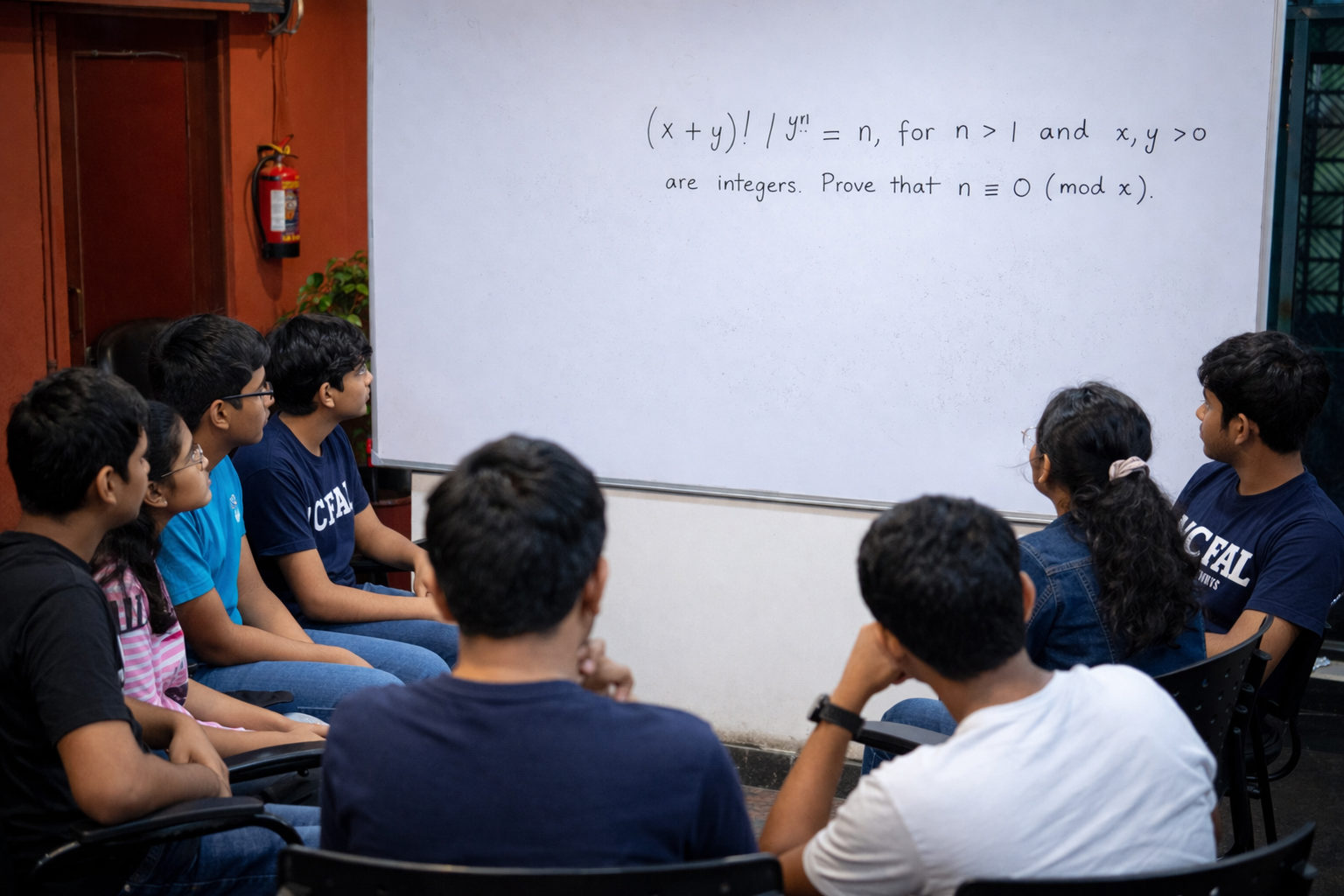
The CFAL Math Circle is modelled after the Berkeley Math Circles — the same approach used at UC Berkeley, where the focus is on the beauty, patterns, and structural integrity of mathematics rather than its utility for speed-oriented exams.
Students are given problems they have not been taught to solve. There is no formula to apply, no algorithm to follow. There is only the problem, the student's mind, and the willingness to sit with it until something opens up. This is "discovery-based" learning — and it replaces the fear of mathematics with the thrill of solving something new.
The sessions are led by research mathematicians and seasoned educators, including Prof. P.N. Subramanya and Dr. Srikanth Pai — faculty whose expertise allows the curriculum to reach depths rarely touched in standard school settings.
The Math Circle is open to all levels — from students just beginning their mathematical journey to seasoned Olympiad aspirants. The only requirement is curiosity.
| Feature | Standard Math Tuition | CFAL Math Circle |
|---|---|---|
| Methodology | Formula-based memorisation | Pattern recognition & discovery |
| Problem Type | Routine, template-driven | Non-routine, puzzle-oriented |
| Learning Environment | Teacher-led, passive | Collaborative, interactive |
| Core Goal | Board exam results | Conceptual clarity & research mindset |
| Mentorship | Standard subject teachers | Research mathematicians & Olympiad experts |
"The Math Circle builds what we call 'problem-solving muscle.' A student who can sit with a single question for hours — without giving up, without reaching for the answer key — that student is ready for JEE Advanced, INMO, or a research career. Most students never develop this skill because they're never given the chance."
The Ramanujan Contest —
10 tests. 10 months. One ranking.
The Ramanujan Contest is not a one-off competition. It is a year-long series of ten tests — held on the last Sunday of each month — designed to identify and nurture mathematical talent among students from Grade 8 to Grade 12.
Each test is two hours of thought-provoking puzzles that challenge the limits of creativity and reasoning. Cumulative points across all ten tests determine the year-end awardees. This structure is intentional: it rewards consistency, grit, and growth over the year — not a single lucky performance.
For younger students (Grades 7–10), CFAL also runs the "Search for the Next Ramanujan" Maths League — a seven-round format where participants count their best six scores. The ₹500 entry fee is refunded once a student completes five of the seven rounds — ensuring that perseverance, not privilege, predicts success.
Foundation Level
Logical puzzles, basic number theory. Book vouchers and fee refunds as rewards. Designed to build curiosity and remove fear of competition.
Competitive Level
Combinatorics, geometry proofs, advanced problem-solving. Top performers earn Olympiad training scholarships.
Olympiad Level
Calculus, advanced algebra, RMO-level preparation. National rank recognition. The pipeline to INMO and international selection.
The Ramanujan Contest is closely aligned with the National Mathematics Talent Contest (NMTC), conducted by the Association of Mathematics Teachers of India. Over 1.2 lakh students participate in NMTC nationally. CFAL students have achieved national-level ranks, including Vishruth Bhat (Grade 6), who secured the 8th national rank — demonstrating that the pipeline begins early and produces results at every stage.
Three Olympiad Camps per year —
where stamina is built.
The national and international Olympiads are not speed tests. The INMO paper has six problems in four and a half hours. A student who cannot sustain deep concentration for hours at a stretch will not clear the cutoff — no matter how talented they are. This stamina is built in the camps.
Camp 1 — Deep Dive
Camp 2 — NSE Preparation
Camp 3 — INMO/RMO Intensive
In 2023, student Muralidhar Rao cleared the INMO with a score of 34/102 — well above the cutoff of 26. A feat attributed to the sustained problem-solving stamina built across these camps. In the same period, Muralidhar also cleared the Indian National Astronomy Olympiad (INAO) — one of the rarest dual qualifications in Indian Olympiad history.
15 years. Every milestone from zero to international.
The names behind the numbers.
Alumni like Aneesh Hebbar and Samarth Bhat have gone from CFAL Math Circle to publishing papers in internationally recognised journals and pursuing PhDs at ETH Zurich. Prathyush Poduval was selected for the Ross Math Camp at Ohio State University — one of the most selective math programmes in the world. These are not isolated stories. They are the products of an ecosystem.
Olympiad training doesn't distract from JEE.
It produces the top JEE scorers.
CFAL rejects the idea that Olympiad training competes with JEE preparation. The original thinking required for Olympiads is the exact skill tested by JEE Advanced. The data proves it: in 2026, all five of CFAL's top JEE Main scorers (averaging 99.91 percentile) were also Science Olympiad National Top 1% achievers.
(national: ~0.5%)
vs national average
vs national average
Mangaluru = CFAL
The student who builds problem-solving muscle in Math Circle at age 13 is the same student who scores in the top 300 of JEE Advanced at age 17. The pipeline doesn't diverge — it compounds.
It begins in Grade 7.
The Math Circle and Ramanujan Contest are delivered through CFAL's Foundation Programme — a structured curriculum of 250–300 hours of expert instruction annually for students in Grades 7 through 10.
In the early years (Grades 7–8), the focus is on Nuffield Science and Berkeley Math Circles — where discovery precedes formal instruction. A child encounters the beauty of a pattern before they learn its name. By Grades 9 and 10, the curriculum becomes increasingly sophisticated — proof-writing, combinatorics, advanced algebra — preparing students for national-level competitions.
Foundation & Curiosity
Linear expressions, algebraic identities, Pythagoras theorem, congruency, simultaneous equations. 250+ hours.
Competitive Edge
Quadratic equations, coordinate geometry, graphs of functions, advanced trigonometry, indices. 250+ hours.
Mastery & Research
Logarithms, complex numbers, binomial theorem, advanced probability, functions and graphs. 250+ hours.
The transition from Grade 7 through Grade 12 is marked by a clear progression: from curiosity and discovery → to competitive problem-solving → to national and international representation. This is not a coaching ladder. It is a mathematical education.
Mentored by research mathematicians.
The Math Circle and Olympiad training at CFAL are not led by standard coaching centre teachers. They are led by people who have spent their careers inside mathematics — as researchers, as professors, as problem-creators.
Prof. P.N. Subramanya and Dr. Srikanth Pai bring a depth of mathematical understanding that allows the curriculum to reach levels rarely seen outside of premier research institutions. Their mentorship is not about giving students answers. It is about teaching them to sit with a problem, to explore it from multiple angles, and to find the path through reasoning — not through formula recall.
Faculty from institutions like IISc and TIFR have chosen to teach at CFAL — because they find that working with young minds who are genuinely curious about mathematics is as fulfilling as guiding doctoral candidates.
Contests, camps, and mathematical surprises.
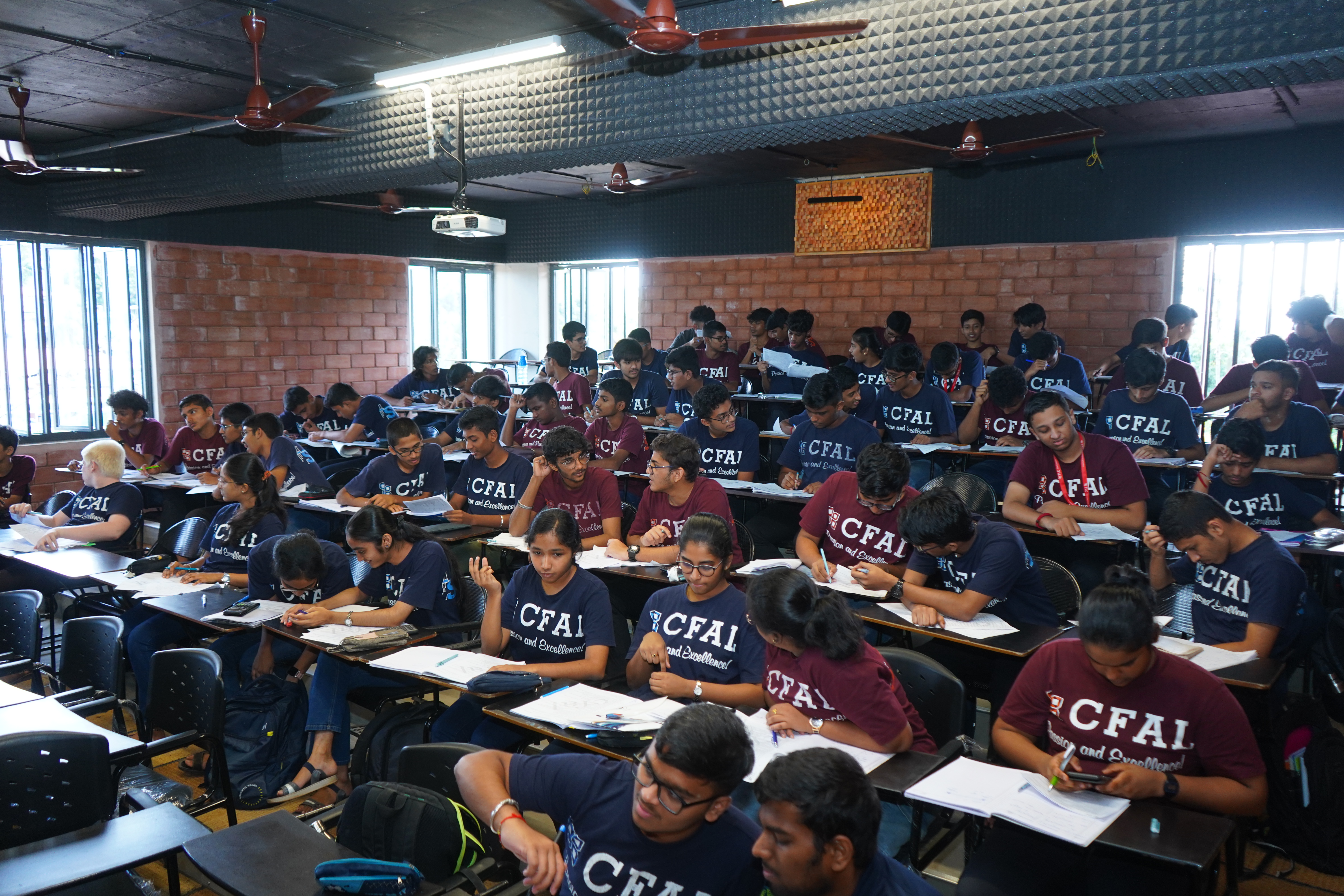
CFAL integrates the National Mathematics Talent Contest (NMTC) into its annual calendar — one of India's oldest and most respected math contests, where over 1.2 lakh students participate nationally. Exposure to NMTC's non-routine problems builds the culture of curiosity that feeds into everything else.
The programme also uses unique activities like the Die Würfelschlange ("The Dice Snake") — what appears to students as a magic trick with dice is gradually revealed to be a stable outcome produced by hidden mathematical structures. Students move from surprise to investigation, discovering convergence and probability through hands-on participation. This embodies the CFAL philosophy: mathematics should surprise you before it instructs you.
Mathematical talent has no zip code.
CFAL's Pragathi Programme provides 100% sponsored coaching to students from government and aided colleges in Mangaluru. The Ramanujan Maths League refunds entry fees for students who complete the majority of the rounds — ensuring that perseverance, not privilege, predicts success.
This commitment means that the ecosystem is not reserved for the economically privileged. The next Aditya Prakash or Prathyush Poduval could come from any school, any background, any family. CFAL's job is to build the ladder. The student's job is to climb it.
The Math Circle is open.
Your child is welcome.
Whether they're a beginner who just discovered they enjoy puzzles, or a student preparing for the Regional Mathematical Olympiad — there's a place for them in the CFAL Math Program.
Math Circle · Ramanujan Contest · Olympiad Camps · Foundation Programme (Grades 7–10)