

Born from a student's idea.
Now representing India in Russia.
In 2015, a student at CFAL wanted to build things — not just study them. A decade later, the MakerSpace has produced Battle of Bots qualifiers, a 1,500-person Makers' Fete, and coastal Karnataka's first world-class STEM summer camp.
It started with a student
who wanted to make things.
In September 2015, a student at CFAL looked at the engineering curriculum and saw something missing: the chance to build. Not on paper. Not in theory. With real tools, real materials, and real consequences. The CFAL MakerSpace was born — not as a top-down administrative programme, but as a student's answer to the question: what if learning meant making?
The early years (2015–2017) were about acquiring industrial-grade tools and establishing a physical space where students could safely make and break things. Summer camps tested a new pedagogical approach — electronics, carpentry, photography — bridging the gap between textbook knowledge and the world it's supposed to describe.
In 2018, a landmark two-month "Circuits and Mechanics" workshop for middle-school students proved that long-term, intensive hands-on engagement could transform how children think about science. The MakerSpace became permanent. By 2019, the Makers' Fete had grown from 100 participants to a regional festival. By 2025, Milestone Marco qualified for the Battle of Bots in Russia.
Four labs. Four weeks.
From consumer to creator.
The Tinker Lab is coastal Karnataka's first world-class STEM summer camp — a four-week immersion for students aged 10 to 15. Every student rotates through all four labs, emerging with skills in engineering, science, construction, and ecology. The student-to-teacher ratio is 8:1 — ensuring every child is seen, guided, and challenged.
Lab 1: The Machine Shop
Students build working machines — from simple levers that lift 500g (teaching mechanical advantage) to Arduino obstacle-avoiding robots that integrate sensors and code. The progression: levers and pulleys → snap circuits with LEDs and motors → bristlebots → programmable robots.
Lab 2: The Nuffield Lab
Students discover scientific principles through experimentation — not by being told the answer, but by finding it. Build a lemon battery to power an LED and discover electrochemistry. Construct a CD spectroscope to see the light spectrum. Test egg floatation to understand density and buoyancy.
Lab 3: The Build Yard
Students learn to work with their hands — sawing, hammering, drilling safely. They build phone stands and catapults from wood, then move to structural engineering: load-testing popsicle stick bridges to understand stress and strain. The capstone: designing and launching water rockets — at least three launches, varying water volume and nozzle pressure to discover the physics of thrust.
Lab 4: The Nature Lab
The CFAL campus becomes a living laboratory. Students master microscopy (examining cells and pond water), conduct biodiversity audits (species inventories and soil pH testing), and build compost bins to understand decomposition and nutrient cycles. The lab culminates in the Tree Census — mapping and measuring every tree on campus with clinometers, contributing real data to CFAL's environmental records.
Milestone Marco.
Battle of Bots. Russia.
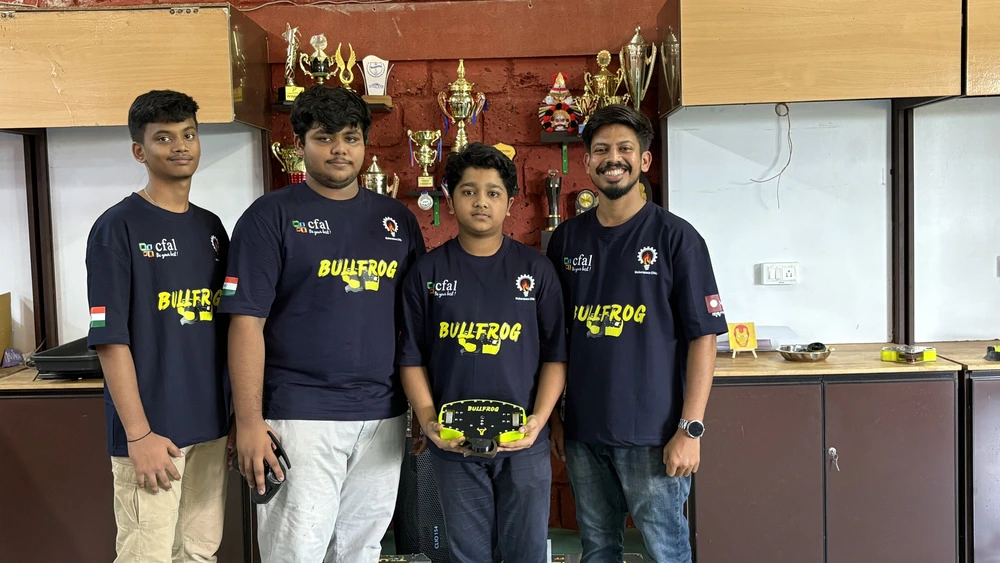
In 2025, the team behind Milestone Marco — led by student Sujan — qualified for the Battle of Bots Grand Finale in Russia. This positioned the CFAL team among the top robotics squads globally, representing India on the international stage.
Battle of Bots is not educational robotics. It is high-intensity combat engineering. The technical demands are immense: high-torque drivetrains capable of rapid acceleration, structural designs that withstand high-velocity impacts, and control systems that blend pilot-led strategy with autonomous responses. The CFAL team built all of this — from the MakerSpace workshop floor.
The team also demonstrated Quadcopters and Obstacle-Detecting Robots at the ROBOSYS technical programme, inspiring younger students at regional events. Milestone Marco is not just a robot. It is proof that a well-supported student initiative in a Tier-2 city can compete at the highest level in the world.
From 100 students to 1,500.
Mangaluru's biggest STEM festival.
What began as a modest internal gathering has become the region's largest maker event. The Makers' Fete now draws nearly 1,500 participants from across Mangaluru and Udupi — students, educators, families — interacting with student projects, competing in engineering challenges, and seeing what happens when children are given real tools and trusted to use them.
Distinguished guests have included Dr. Ramachandra Hebbar from ISRO, who spoke on the importance of early exposure to research and innovation. The 2025 Fete featured tree plantation ceremonies alongside robot battles — technology and ecology, side by side. That duality is the MakerSpace in a single image.
From maker to entrepreneur.
In the final week of the summer camp, student teams stop building and start selling. Business Day transforms the MakerSpace from a workshop into a marketplace.
Teams of five form "companies." They choose products to manufacture from their MakerSpace projects — bristlebots, LED bottles, interactive science demonstrations. Then they do everything a real business does: pricing strategies, marketing posters, projected profit-and-loss statements. The CFAL Market opens to parents and the community, where students sell their products for real currency.
The exercise ends with each team presenting their final P&L to a panel of judges. They track material costs, total revenue, and final profit or loss. Awards go to Highest Profit, Best Marketing, Most Creative Product, and the CFAL Spirit Award — for the student who helped others the most.
This is where engineering meets economics. A child who can build a bristlebot AND explain its unit economics to a panel of judges has learned something no textbook teaches.
Industrial-grade tools.
In the hands of students.
The MakerSpace provides access to equipment typically reserved for university engineering labs or professional workshops. This is not a toy workbench. These are the tools that built Milestone Marco.
3D Printers
Additive manufacturing. Students create complex mechanical parts, custom robot components, and functional prototypes from digital designs.
Laser Cutters
Precise cutting and engraving for structural, mechanical, and artistic projects. Clean edges, repeatable precision.
Electronics Lab
Advanced soldering stations, oscilloscopes, microcontrollers, sensors. From basic circuits to autonomous robot control systems.
Observatory
The Astrophysics Club's 127mm APO refractor and ASI071MC Pro camera. Students build custom mounts and sensor systems here.
The transition from sketch to prototype happens in this room. A student draws an idea on paper in the morning. By afternoon, it's a 3D-printed part attached to a laser-cut frame with a soldered circuit board inside. That cycle — from concept to physical object in hours — is what transforms students from consumers of technology into creators of it.
Not just hands-on.
Hands-on with a philosophy.
The MakerSpace operates on two pedagogical frameworks that are woven into everything students do:
The Nuffield Method: "I do and I understand." Students don't verify laws they've been told about. They discover principles through experimentation before being given the theory. A child who has built a lemon battery and felt the LED light up understands electrochemistry in a way that no diagram can provide. This is the UK Nuffield methodology — provocation, investigation, discovery, recording, extension.
The Berkeley Math Circle Model. Mathematics in the MakerSpace is not formulas on a board. It is collaborative problem-solving — puzzles, real-world calculations (mechanical advantage, thrust equations, P&L statements), and the kind of reasoning that makes engineering possible. When a student calculates the number of rope segments needed for a pulley to lift 500g, they're doing mathematics with their hands.
And here's what surprises people: hands-on learning doesn't distract from competitive exam performance. It enhances it. In 2026, CFAL students achieved 99.96 percentile in JEE Main — with 10 students above 99.5 percentile. The conceptual clarity gained through building science provides a more robust foundation for complex problem-solving than memorisation ever could.
Top CFAL scorer, 2026
percentile (9× national rate)
participants
Grand Finale
The campus is a living laboratory.
The MakerSpace maintains a deep connection with environmental science through the Tree Census Project. Students map and measure every tree on the CFAL campus using clinometers and technical tools, creating a species inventory that contributes real data to the institution's environmental records. This is not a classroom exercise — it is a longitudinal research project unveiled at the annual Maker Fair.
The broader Amara initiative has overseen the planting of thousands of trees and the mapping of urban biodiversity. Tree plantation ceremonies at the Makers' Fete symbolise the institution's belief that excellence in science and technology must be coupled with environmental responsibility. A student who builds a robot AND plants a tree has understood something about the world that pure engineering cannot teach.
Build it. Prove it. Own it.
The MakerSpace is open to all CFAL students. The Tinker Lab summer camp runs April–May for ages 10–15. The Makers' Fete is open to the region. Whether your child wants to build a robot, launch a rocket, or start a business — this is where it begins.
Tinker Lab · MakerSpace Club · Makers' Fete · Business Day