

April 2026 · Ages 10–15 · Only 100 Seats
CFAL TINKER LABBuild It. Prove It. Own It.
The only summer camp in coastal Karnataka where every child builds 20+ real projects, discovers science through experiments, solves problems like a mathematician, runs a real business, and presents at a public Maker Fair.
4
Labs to master
20
Days of making
20+
Artifacts built
8:1
Student-teacher
ratio
ratio
⚡ Last year sold out in 3 weeks. Early registration open now.
This is not a show-and-tell camp
Most summer camps show your child cool things.
At Tinker Lab, your child builds them.
Every single activity ends with a tangible artifact — something your child built, tested, iterated, and can explain. A working robot. A lemon battery. A water rocket launched three times with different variables. A business that made actual profit. A scientific poster with real data.
After 4 weeks, your child comes home with a portfolio of 20+ projects, a lab notebook, a presentation they delivered on stage, and a mind that works differently.
"I hear and I forget. I see and I remember. I do and I understand."
— Nuffield Foundation motto
— Nuffield Foundation motto
4 labs · 4 weeks · Every child rotates through all four
The Four Labs of Tinker Lab
Lab 1 · The Machine Shop
Engineering & Robotics
"From Idea to Machine"
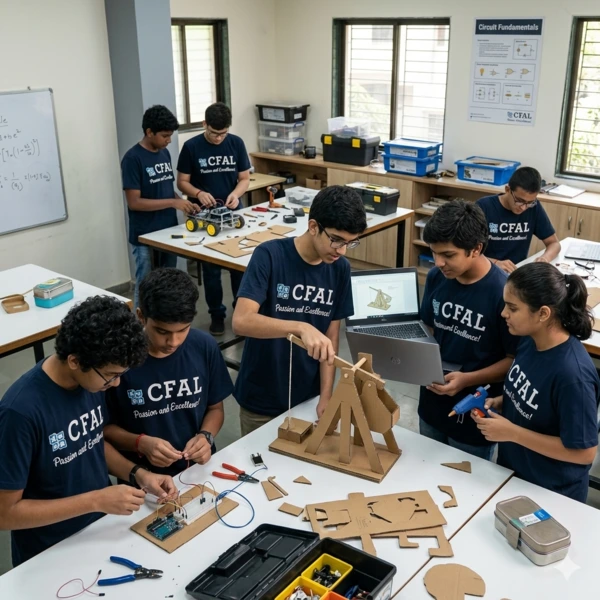
Build levers and pulleys that lift 500g. Wire snap circuits with LEDs, buzzers, and motors. Race bristlebots. Construct cam-driven mechanical toys. Program an obstacle-avoiding robot with Arduino. Present your best creation on Demo Day.
Your child builds: Working circuit Bristlebot Cardboard automata Programmed robot
Lab 2 · The Nuffield Lab
Guided Discovery Science
"I do and I understand."
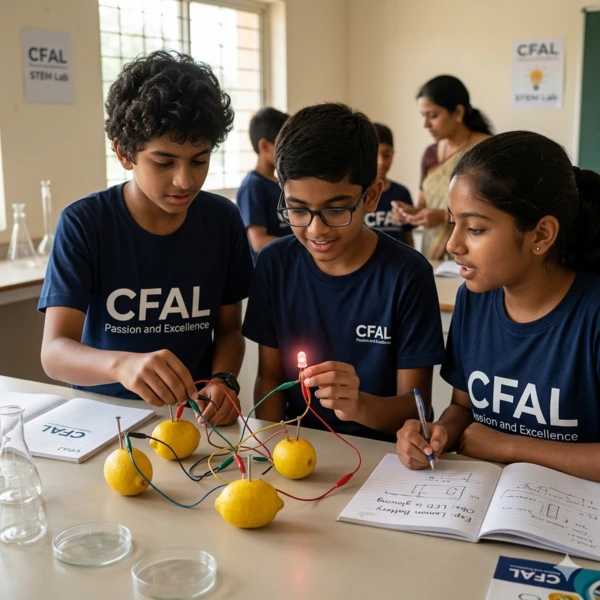
Can you make an egg float? What is fire eating? Can a lemon power an LED? Why is the sky blue? Students are never told the answer first — they experiment, observe, record, and discover the science themselves. Every day follows the Nuffield Cycle: Provocation → Investigate → Discover → Record → Extend.
Your child builds: Foil boat Lemon battery Spectroscope from a CD Complete Lab Notebook
Lab 3 · The Build Yard
Carpentry, Rockets & Structural Engineering
"Measure Twice. Build Once. Launch It."
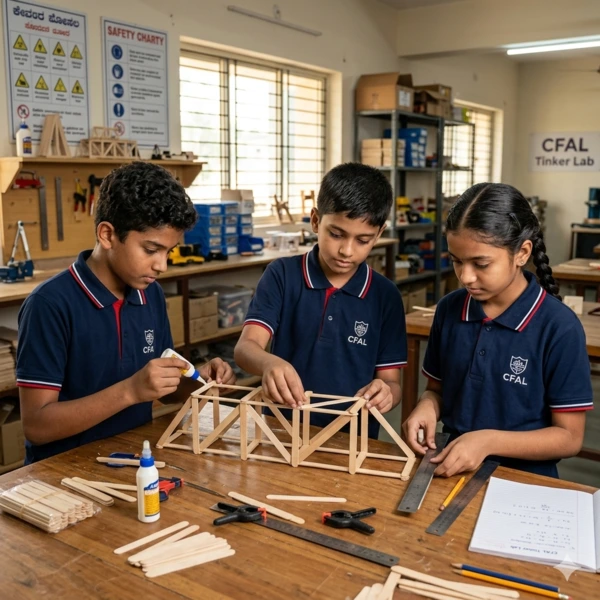
Measure building heights with clinometers and similar triangles. Build popsicle stick bridges and test to destruction. Learn safe carpentry — saw, hammer, drill — and build a phone stand. Design and iterate water rockets (minimum 3 launches with different variables). Build a catapult for the final accuracy competition.
Your child builds: Clinometer Bridge (load-tested) Wooden item Water rocket Catapult
Lab 4 · The Nature Lab
Ecology, Life Sciences & Environmental STEM
"The Living Campus"
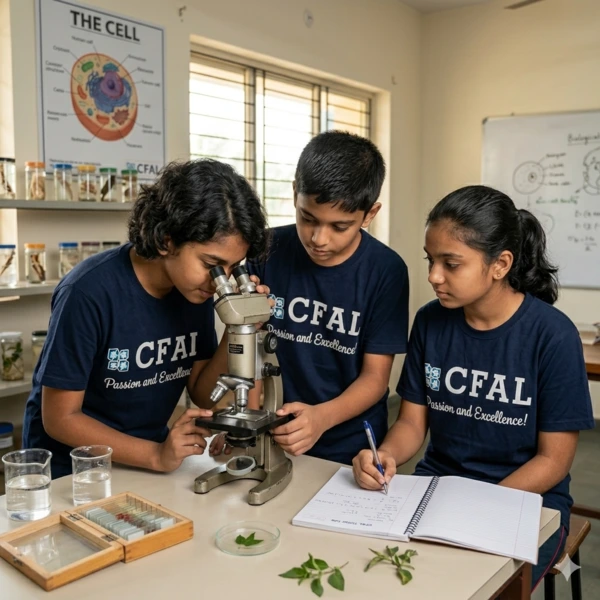
Master the microscope — examine pond water, soil, leaves, onion skin, cheek cells. Conduct a campus biodiversity audit and calculate a real biodiversity index. Dissect a fish. Test soil pH. Build a vermicompost bin. Map and measure every tree on campus — contributing real data to CFAL's ongoing environmental research.
Your child builds: 5 scientific drawings Species inventory Compost bin Tree census data Ecosystem poster
A typical day at Tinker Lab
9 AM to 2 PM · Monday to Friday
9:00 – 9:15
Morning Circle
Curiosity question of the day. Safety briefing. Set intentions.
9:15 – 11:15
Main Lab 2 hours of making
Machine Shop, Nuffield Lab, Build Yard, or Nature Lab — rotating weekly. Hands-on, artifact-driven, facilitator-guided.
11:15 – 11:45
Lunch + Free Play
Time to eat, breathe, run, and be a kid.
11:45 – 12:30
Math Circles Daily
Berkeley-style problem solving. Math as play, puzzle, and proof. Every child, every day — because thinking is a muscle.
12:30 – 1:15
STEM Presentations / Business Prep Skills
Weeks 1-2: Prepare and rehearse a 3-minute TED-style talk on a science topic. Weeks 3-4: Form companies, create products, build marketing, prepare for Business Day.
1:15 – 1:50
Special Rotation Bonus
Tree Census with Smitha. Herbarium with Rashmi Bhat. LED Bottle making. Mangalore tile painting. Heritage and nature meet STEM.
1:50 – 2:00
Gallery Walk + Closing Circle
Display what you made today. Walk through other students' work. Reflect. Celebrate.
The grand finale
Business Day + CFAL Showcase
Day 23 · Business Day — "The CFAL Market"
Your child runs a real business for a day.
Teams of 5 form companies. Choose products from things they've built. Create pricing, marketing posters, and a projected P&L statement. Open to parents and community.
- Sell bristlebots, LED bottles, lemonade, science experiences
- Track material costs, revenue, profit/loss
- Present P&L statements to judges
- Awards: Highest Profit, Best Marketing, Most Creative Product
Day 24 · The CFAL Showcase — Maker Fair + Awards
100 students. 400+ artifacts. One incredible exhibition.
Every portfolio on display. LED bottle gallery in a darkened room. Student TED talks on stage. Math Circles live puzzle. Tree census results unveiled. Awards ceremony. Professional photos.
- Parents walk through the gallery with children as guides
- 8-10 best student TED talks (3 min each)
- 11 awards from Best Engineer to The Tinkerer Award
- The CFAL Spirit Award (peer-voted — helped others the most)
For parents wondering
Why Tinker Lab is different from every other camp
🔧
Every activity produces a real artifact
No show-and-tell. No watching a demo. Every child builds, tests, iterates. They come home with 20+ projects they made with their own hands — from robots to rockets to compost bins.
🔬
UK Nuffield science + Berkeley Math Circles
The Nuffield Foundation's guided discovery method (used across British schools) and Berkeley's Math Circle approach (used at UC Berkeley). Your child discovers principles through experiments — not through lectures. These aren't just activities; they're internationally recognised pedagogies.
👥
8:1 student-teacher ratio. 16 staff for 100 kids.
4 lab leads, 4 lab assistants, Math Circle facilitators, special rotation experts, a safety officer, and a camp coordinator. Every child is known, tracked, and supported.
🎤
They learn to present, pitch, and sell
STEM Presentation training: every child prepares a 3-minute talk. Business Day: they price, market, sell, and track profit. These are life skills that no textbook teaches — and most summer camps don't touch.
🌳
It's from CFAL — Mangaluru's #1 STEM institution
The same institution that sent a student to the International Math Olympiad in Brazil. That won a Silver Medal at the Astrophysics Olympiad in Beijing. That produces 10x the national JEE average. Tinker Lab is built on the same philosophy — just with more fun, more mess, and more rockets.
The question we ask on the last day
"What can you build now that you could not build 4 weeks ago?"
— The only question that matters. Asked in the Closing Circle, Day 24.
100 seats. 4 labs. One unforgettable summer.
April 7 to May 3, 2026. Monday to Friday, 9 AM to 2 PM. Ages 10-15. CFAL Campus, Akashbhavan, Mangaluru.
Dates: April 7 – May 3, 2026 (4 weeks, Mon–Fri)
Time: 9:00 AM – 2:00 PM daily
Ages: 10–15 years
Seats: 100 only (4 cohorts of 25)
Includes: All materials, lab notebooks, portfolio, Maker Fair entry, professional photos