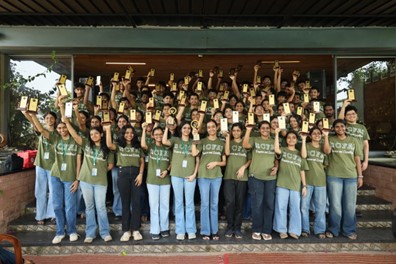




When a Row of Dice Starts to Feel Like Magic
Some mathematical ideas are best introduced not with a formula, but with a surprise.
That was exactly the spirit of our recent Die Würfelschlange activity- literally, the “dice snake.” At first glance, it looked like a magic trick. A row of dice was laid out. A student secretly chose one of the first six dice as a starting point. Then, following a simple rule, the student moved forward: if the die showed 4, they jumped ahead 4 places; if it showed 2, they moved 2 places, and so on, repeating the process until no more moves were possible.
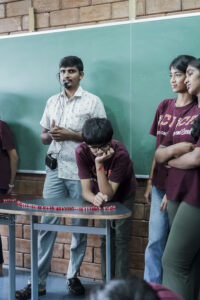 Meanwhile, the facilitators, Dr. Aditya and Mr. Shivarama, looked only at the arrangement of dice and confidently predicted the final die the student would land on.
And they were right. More than once.
The Surprise Behind the Surprise
What made the activity so delightful was that it genuinely felt mysterious at first. How could someone predict the end point without knowing where the participant began?
The answer lies in a beautiful mathematical idea: Convergence.
The facilitators were not reading minds. They were simply following the same jumping rule, but starting from the very first die in the row. Even if the participant began somewhere else among the first few dice, the two paths would often merge after a small number of jumps. Once the paths met, they became identical. From that point onward, both the participant and the facilitator were forced to follow the same route to the same ending.
What appeared to be magic was really structure.
From Performance to Investigation
 After watching the trick a few times, students began to notice patterns. The real learning began at that moment: when the room shifted from “How did they do that?” to “Why does this happen?”
Students were then split into smaller groups and asked to repeat the experiment using fewer dice. This changed everything.
Now the trick did not always work.
Different starting points sometimes led to different endings. Students quickly observed two important ideas:
- With fewer dice, there are more possible final end points.
- With more dice, paths tend to merge, making a common end point more likely.
This was a powerful moment. Students were no longer just watching a clever demonstration; they were beginning to test a conjecture. They were noticing that size matters, and that randomness can still produce regularity.
A Lesson in Mathematical Thinking
 The Die Würfelschlange activity worked so well because it brought together several layers of mathematical thinking at once.
At the surface, it was a game. Just below that, it was a puzzle.
And underneath it, it opened a door into probability, processes, and the idea that repeated steps can produce stable outcomes.
This is one of the pleasures of mathematics: simple rules can lead to unexpected patterns. A row of ordinary dice can become a laboratory for asking deep questions:
- When do different paths merge?
- How likely is convergence?
- How does the number of dice affect the result?
- When does a trick stop being a trick and become a theorem?
Why Activities Like This Matter
 What made this session especially valuable was not only the final explanation, but the journey students took to get there. They experienced wonder first, then pattern, then reasoning. That sequence matters.
Too often, students meet mathematics only after the mystery has been removed. Here, they encountered mathematics the way mathematicians often do: through curiosity, experimentation, failure, revision, and insight.
The Die Würfelschlange reminded us that mathematics is not merely about getting answers. It is about learning to see hidden order, even in something as simple as a line of dice.
And sometimes, the best way to begin is with a little magic.
At CFAL in Mangaluru, activities like Die Würfelschlange are part of a larger commitment to inquiry-based mathematical thinking.